Guide
E-invoicing from 1 January 2027: what you need to get done in time
From January 2027, a VAT payer will send an invoice to a Slovak company as data via a certified delivery service, not as a PDF by email. We explain who this affects, what changes in practice, and what to get done before the end of the year.
 Norbert Kovalčínfounder · STENVARD27 September 2026
Status as of 26 September 2026. This is not legal advice. We explain what the law says and what the Finančná správa (the Slovak Financial Administration) states. Check your own case with your accountant or tax adviser.
What is changing
From 1 January 2027, a VAT payer must issue an invoice to a Slovak company or organisation as an electronic invoice. It sends it via a certified delivery service, which the Finančná správa calls the Digitálny poštár (the Digital Postman, the Financial Administration’s name for a certified delivery service). Every business must be able to receive such an invoice, even one that is not a VAT payer.
A PDF by email will not be enough from January. The invoice will go through as data, via the Digital Postman.
This was introduced by Act No. 385/2025 Coll., approved by the Národná rada (the Slovak Parliament) on 9 December 2025. It amends the VAT Act. The European framework is provided by Council Directive (EU) 2025/516, which has allowed member states to introduce mandatory domestic e-invoicing since April 2025.
Who this affects
Who must issue an e-invoice
A VAT payer that supplies goods or a service in Slovakia to a Slovak company, sole trader or other legal entity, for example a foundation or a public institution. The same applies when it receives an advance payment from them. The size of the company does not matter.
Who must be able to receive one
Every legal entity and every business. This includes a sole trader who is not a VAT payer, a solicitor, an architect, a self-employed farmer or a property landlord. The Finančná správa states this clearly: even businesses that do not issue e-invoices themselves need a Digital Postman so they can receive them. Public procurers must also receive invoices through the delivery service.
What the obligation does not cover
- sales to consumers, that is, to people who are not running a business,
- supplies exempt from VAT,
- a simplified invoice, for example an eKasa (Slovakia’s online cash register system) receipt up to €400,
- invoices sent abroad; cross-border supplies are only covered from 2030,
- foreign companies registered in Slovakia only under § 5 of the VAT Act.
On the other hand, an e-invoice is also mandatory for an advance payment, for a corrective invoice and credit note, and under the reverse charge.
When
- 2026: voluntary. You can send an e-invoice through the Digital Postman if your customer has one too.
- From 1 January 2027: mandatory for domestic supplies.
- From 1 July 2030: the obligation extends to cross-border supplies. The kontrolný výkaz (VAT control statement) and the súhrnný výkaz (EC recapitulative statement) are filed for the last time for the period ending 30 June 2030.
What is an e-invoice, EN 16931 and Peppol
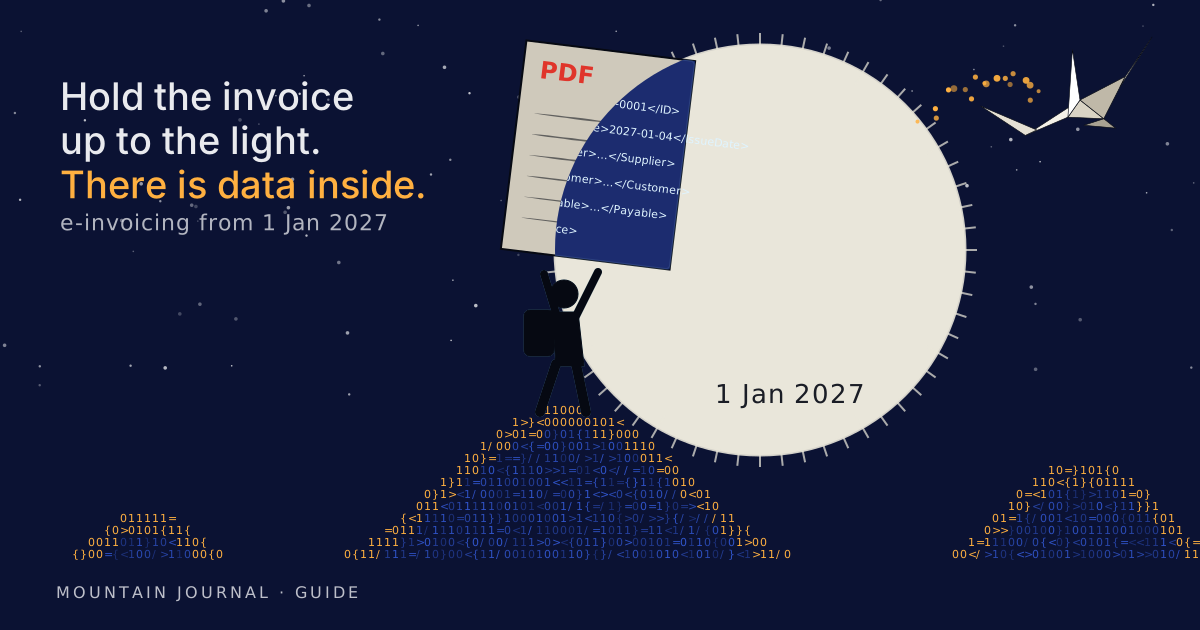
An e-invoice is an XML file with structured data under the European standard EN 16931. Accounting software reads it without anyone retyping it. According to the Finančná správa, a PDF is only an image document; it is not an e-invoice. Nor is a scan.
EN 16931 is the European standard that sets out what data an invoice carries and in what form. It allows two syntaxes, UBL and CII. The Act refers to it via a Commission Implementing Decision.
Peppol is a European network for the secure exchange of business documents. The Finančná správa compares it to a digital postal service for invoices. Slovakia uses the Peppol BIS Billing 3.0 format within it, which is a refinement of the EN 16931 standard. The network finds the customer by their DIČ (tax identification number).
An access point is the gateway into Peppol. The Act calls it a certified provider of the delivery service; the Finančná správa calls it the Digital Postman. The list of providers is kept by the Finančné riaditeľstvo (the Financial Directorate, which is also Slovakia’s Peppol Authority). As of 25 September 2026, it listed 77 providers.
Under the Act, the Digital Postman checks the invoice’s formal requirements, reliably identifies the sender and the recipient, and guarantees that the content does not change in transit. It records the date and time of sending, delivery and receipt. It reports the invoice data to the Finančná správa itself.
What this means for you
- Have a Digital Postman. Every business needs one, even if it only receives invoices. You choose your own from what the market offers.
- Issue the e-invoice within 15 days, if you are a VAT payer. The deadline does not change.
- Keep the data on the invoice correct. The Digital Postman reports it to the Finančná správa, but you remain responsible for the data. A fine of up to €10,000 applies for data not reported, reported late or incorrect, rising to up to €100,000 for repeat offences. You will not be fined for an obvious error you correct, or for a proven fault at the Digital Postman’s end, provided the data is reported as soon as the fault is fixed.
- Keep the e-invoice for 10 years, in XML. The Digital Postman does not have to archive it. The archive is yours.
If you issue or receive only a few dozen invoices, the Finančná správa says an account in the Digital Postman’s application is enough. You can download the invoices from it, or give your accountant access to it. The provider sets the price. The Finančná správa expects a simple application’s subscription to cost no more than the EU average, that is, €5 to €12 a month.
Some accounting programs will have the Digital Postman built in directly. In the Finančná správa’s list as of 25 September 2026, STORMWARE, the maker of POHODA, appears as a certified provider, and SuperFaktúra as an intermediary of a certified provider. You can check where your program stands using the Finančná správa’s provider-selection application, and with its maker.
What changes in practice
Sending
You issue the invoice for a Slovak company in your program, and it goes out via the Digital Postman. A PDF by email will not replace it. From January, you can issue a summary invoice for at most one calendar month, not a quarter. You cannot correct an error on a sent invoice by rewriting it. The Finančná správa recommends a credit note and a new invoice, both sent through the Digital Postman.
Example: you invoice a construction company that does not yet have a Digital Postman. You send the invoice through your own Digital Postman, and the delivery ends in an error. According to the Finančná správa, you have met your obligation regardless. But until your customer has the invoice, they can hardly pay it. It is therefore worth alerting your customers now.
Receiving
Invoices from Slovak VAT payers will reach you through the Digital Postman, either into its application or directly into your accounting program. If you do not have a Digital Postman, the invoice will not reach you, and the supplier will still have met its obligation.
Without a Digital Postman, the invoice will not reach you. Yet the supplier has met its obligation.
Example: a Slovak materials supplier, a VAT payer, has been sending you a PDF until now. From January, it will send XML through the network. Once your program reads it, there is nothing left to retype. All that remains is to check and approve the invoice.
Delivery does not mean acceptance. You cannot reject an incorrect invoice through Peppol. You contact the supplier and ask for a credit note, as before.
Retyping will not disappear entirely. Invoices from abroad, from non-VAT-payers, and eKasa receipts and slips will keep arriving just as they do today.
Archive
You keep the e-invoice for 10 years from the end of the year it relates to, in XML. A printed or saved PDF is not enough. The Accounting Act says the same thing: if a record is to be created in an electronic format, it is also kept in that same format.
Filings
You keep filing the kontrolný výkaz as before, up to the period ending 30 June 2030. The e-invoice does not replace it yet.
Checklist for October to December 2026
- Check whether you are a VAT payer. If so, you both issue and receive e-invoices. If not, you only need to receive them.
- List who you invoice: Slovak companies and organisations, consumers, abroad. The e-invoice only concerns the first group.
- Ask your software’s maker whether it will issue an invoice in XML under Peppol BIS Billing 3.0, whether it will read a received e-invoice, from which version, and through which Digital Postman.
- Choose your Digital Postman from the Finančná správa’s list. Compare prices and check that it is listed as a certified provider or its intermediary.
- Check the DIČ, both your own and your customers', in your program’s address book. The network finds the recipient by their DIČ.
- Try it out during 2026. Send and receive a few invoices with a partner who is already on the network. You can find one in the Peppol Directory.
- Agree with your accountant who has access to the mailbox at the Digital Postman, and who takes over and approves received invoices.
- Adjust your habits: a summary invoice for at most a month, corrections via a credit note and a new invoice, the 15-day deadline.
- Set up your XML archive for 10 years: where it will be, who backs it up, and how you will find a specific invoice in it during an inspection.
- Tell your partners that from January you will be sending and receiving through the Digital Postman, and find out which of them is not yet ready.
Common misconceptions
“We are not VAT payers, this does not concern us.” It does. Every business must be able to receive e-invoices.
“A PDF sent by email is an electronic invoice.” It is not. An e-invoice is XML that a program reads without retyping.
“We keep our invoices as PDFs, so the archive is sorted.” You need to keep the XML, and for 10 years.
“The kontrolný výkaz ends in January.” It does not. It is filed up to the period ending 30 June 2030.
“We will report to the Finančná správa by hand.” The Digital Postman does this. You are responsible for making sure the data on the invoice is correct.
“An e-invoice is not needed under the reverse charge.” It is. The invoice simply carries a different VAT code.
“We will reject an incorrect invoice on the network.” You cannot reject one through Peppol. You need to contact the supplier.
Where we can help, and where we can’t
We will not sell you a Digital Postman or a new accounting program. If you issue and receive a few dozen invoices a month and nobody retypes them, your program and a Digital Postman are enough. You do not need us for that.
It is worth it when data is retyped by hand today: from emails, from documents, from bank statements. That is where we connect the accounting software you already have. Kovrin, our system, takes over the document from the email. It prepares it and records it. Anything that touches money or leaves the company waits for your click. Every step leaves a record behind.
Sources
- Act No. 385/2025 Coll., promulgated text, Slov-Lex (in Slovak). Approved 9 December 2025, promulgated 19 December 2025. Who issues and to whom: § 85o para. 2 and 3. Who must be able to receive: § 71 para. 5. What an electronic invoice is: § 71 para. 1(b) and § 85o para. 4. Corrections via the delivery service: § 85o para. 5. The 15-day deadline: § 85o para. 6. Summary invoice per month: § 85o para. 7. Reporting via the delivery service: § 85o para. 9 to 11. Fines and when they are not imposed: § 85o para. 12 to 14. 10-year archive: § 85o para. 15. Control statement and recapitulative statement up to 30 June 2030: § 85o para. 17, Art. I point 53 and Art. VIII. Year 2026: § 85o para. 21 and 22. Delivery service, provider obligations and the list: § 76a. Archive in electronic format: Art. III point 6 (§ 35 para. 2 of the Accounting Act). Public procurers: Art. VII. Effective date: Art. VIII.
- Finančné riaditeľstvo SR (the Financial Directorate of the Slovak Republic), Frequently Asked Questions on eFaktúra, 9/DPH/2025/IM, version of 15 September 2026 (in Slovak). Recipients including non-VAT-payers: examples No. 7 and 62. Consumers: No. 4. Exempt supplies: No. 58. eKasa up to €400: No. 66. Abroad: No. 16. Registration under § 5: Part II, No. 29. Advance payment: No. 38. Deadline and corrections: No. 13 and 50. Rejecting an invoice: No. 11 and 60. Year 2026: No. 14 and 15. XML and PDF: No. 1 and 3. DIČ on the Peppol network: No. 39. The Digital Postman: No. 6. Price: No. 10. Reporting and fines: No. 18. Customer without a Digital Postman: No. 42. Archive in XML: No. 59 and Part II, No. 18. Summary invoice: Part II, No. 41. Code AE for the reverse charge: Part III. Year 2030: No. 62.
- Finančná správa, e-Faktúra page (in Slovak). Peppol described as digital post for invoices, with links to the provider list and technical documents.
- List of certified delivery service providers as of 25 September 2026 and the Finančná správa’s provider-selection application (in Slovak). 77 providers, STORMWARE s.r.o. as a certified provider, SuperFaktúra, s.r.o. as an intermediary.
- Council Directive (EU) 2025/516 of 11 March 2025, EUR-Lex. Mandatory domestic e-invoicing: Art. 1 point 2 and Art. 6(1). Changes from 1 July 2030: Art. 5. Abolition of recapitulative statements: recital 14 and Art. 5 point 18.
- Commission Implementing Decision (EU) 2017/1870, EUR-Lex. Standard EN 16931-1:2017 and its two syntaxes, UBL and CII.
- Peppol, Slovakia country profile. Finančné riaditeľstvo SR as the Peppol Authority, Peppol BIS Billing in Slovakia.
- Peppol BIS Billing 3.0. A refinement (CIUS) of the EN 16931 standard.
- Peppol Directory. Who is already on the network.